
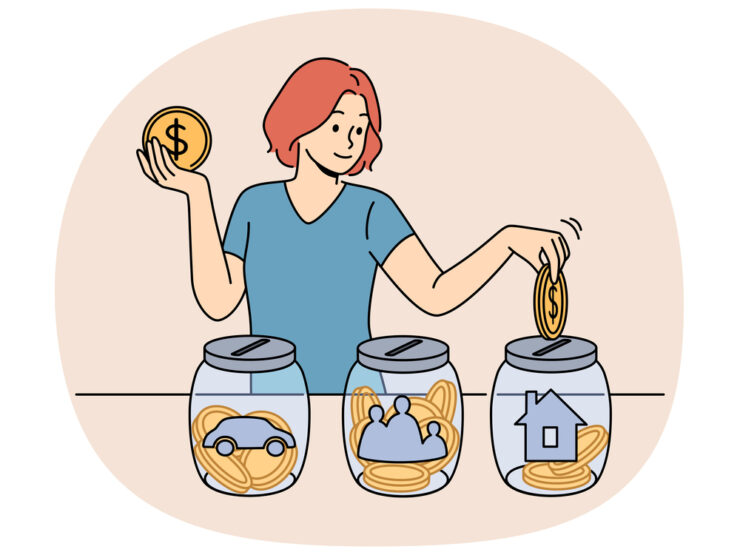
If you’ve ever made a budget, felt absolutely fantastic about it for approximately six minutes, and then never looked at it again, congratulations. You’re completely human, and you’re in very good company.
Here’s the thing: most budgets fail not because people lack discipline or willpower or any of the other character traits we’re told we need more of. They fail because the budgets themselves are fundamentally broken.
They’re too rigid, treating every month like it’s exactly the same when real life is anything but predictable. They ignore your actual life, your actual habits, your actual challenges. They feel like punishment, like you’re putting yourself on financial restriction for crimes you didn’t commit. And worst of all, they rely entirely on willpower, which for most of us runs out somewhere around Tuesday afternoon.
A budget you can actually stick to doesn’t demand perfection from you. It creates structure, flexibility, and clarity that work with your life instead of against it.
This post walks you through exactly how to build a budget that supports you instead of making you feel like you’re constantly failing at being a responsible adult.
Because the problem isn’t you. It’s the kind of budget you’ve been taught to use.
What a Budget Actually Is (Not What You Think)
Let’s start by clearing up some major misconceptions, because most of us have been taught completely wrong ideas about what budgets are supposed to be.
A budget is not a spreadsheet with 47 categories that you update daily. It’s not a restriction that tells you not to do everything enjoyable. It’s not a “no fun allowed” punishment system for having the audacity to want things.
A budget is simply a plan for your money that matches your real life, your actual goals, and your emotional patterns around spending.
A great budget does three specific things. It controls your essentials so you’re never caught off guard by bills you knew were coming. It protects your goals, so you actually see progress every single month instead of just hoping progress happens someday. And it allows guilt-free spending, so you don’t eventually rebel against the whole system.
When a budget has all three of those elements, it becomes sustainable. And sustainable is what actually builds wealth over time, not perfect.
The Simple Truth About Money Planning
Imagine your money is like Lego bricks. You get a new pile every month when your paycheck comes in.
You can use some bricks to build your house; those are your essentials. You can use some bricks to build something cool you’ve been planning; those are your goals. And you can use some bricks to just play and have fun, because what’s the point of having Legos if you can’t enjoy them?
A good budget simply tells you how many bricks go where. It doesn’t take away your whole pile and tell you that building anything is irresponsible. It doesn’t make you feel like you can’t play anymore.
It just helps you be intentional about what you’re building instead of randomly throwing bricks around and wondering why nothing ever comes together.
That’s it. That’s budgeting.
How to Actually Build a Budget That Works
Start with real numbers, not fantasy ones
Most budgets fail right out of the gate because people guess what they spend instead of actually checking. You think you spend $200 on groceries when it’s really $420. You estimate $50 on coffee and treats when it’s actually $120.
Your first job is to gather your actual data. Pull up your bank statements for the last 30 to 90 days. Look at your card history. Make a list of your recurring bills and subscriptions. Don’t forget irregular expenses like haircuts, car maintenance, gifts, and annual fees.
This isn’t about judging yourself. It’s about seeing your actual spending patterns so you can build a budget around reality instead of aspirations.
This step alone often reveals your biggest money leaks. The subscriptions you forgot about. The categories where you’re consistently spending way more than you realized. That’s valuable information.
Create three simple categories, not twenty-five
Forget the budget spreadsheets with micro-categories for every possible type of expense. You don’t need separate lines for “coffee shops,” “bakeries,” “casual dining,” and “fast food.” That’s how you end up overwhelmed and quit.
You only need three categories: Essentials, Goals, and Life/Fun Money.
Essentials are rent or mortgage, groceries, utilities, transportation, insurance, and minimum debt payments. The non-negotiables that keep your life functioning.
Goals are savings, extra debt payments beyond minimums, emergency fund contributions, and sinking funds for things like car maintenance, gifts, or travel.
Life/Fun Money is eating out, beauty and self-care, shopping, entertainment, hobbies, and anything else that makes life enjoyable.
When you simplify, you actually stick to it. When you overcomplicate, you quit before you even really start.
Use what I call the “Money Map” method
This is honestly the easiest budgeting framework for busy people who don’t want to spend hours managing spreadsheets.
When your paycheck comes in, it splits into three buckets: Essentials, Goals, and Fun. That’s it.
Here’s the key part that’s different from traditional budgeting. Your goals come out first. You pay yourself before you pay anyone else. This is non-negotiable savings and debt payoff that happens automatically.
Your fun category is completely guilt-free because it’s pre-approved. You decided this is reasonable, and you get to enjoy it without shame.
Your essentials get what they need, and you’ve already seen the numbers, so you know what that is.
This is budgeting without the chaos and without the shame spiral of feeling like you failed every time you do something enjoyable.
Automate everything you possibly can
Here’s a truth that will set you free: automation equals success. Willpower and good intentions do not.
Set up automatic savings transfers. Set up automatic bill pay for your essentials. Set up automatic debt payments. Set up automatic sinking fund transfers if you’re using those.
When the right financial behaviors happen without you having to touch them, think about them, or rely on motivation, your budget becomes effortless.
Consistency beats motivation every single time. Automated consistency is the absolute winner.
Build in safety cushions because life is unpredictable
Budgets fail spectacularly when we pretend every month is going to be exactly the same and nothing unexpected will ever happen. That’s not real life.
Add buffer money to your budget. Maybe it’s $20-50 per week that you can use for whatever comes up. Maybe it’s a miscellaneous fund of $40-60 per month. Maybe it’s a personal “oh no” stash of $25-50 for genuine surprises.
These little cushions prevent one unexpected thing from completely wrecking your whole month and sending you into a shame spiral where you abandon the entire budget.
Adjust monthly, not daily
Another huge reason budgets fail is that people think they need to track every single dollar every single day. That’s exhausting. That’s unsustainable for most people with actual lives to live.
Your budget is not a surveillance tool. It’s a map. It’s guidance, not a prison.
Check it once a week for small tweaks if you want. Check it once a month for bigger adjustments based on what actually happened. That’s enough.
Your life changes. Your expenses change. Your priorities shift. Your budget should be flexible enough to change with you, not so rigid that any deviation feels like failure.
Why Most Budgets Fail (What the Research Says)
Research on personal finance habits reveals some pretty important patterns that explain why so many people, especially women, struggle with traditional budgeting.
First, women are 20-30% more likely than men to abandon budgets due to underestimating daily spending. A 2025 Fidelity study of over 2,000 women found that 62% underestimated habitual costs like groceries and subscriptions by 25% or more. This leads to constant frustration and eventual dropout. The problem is compounded by what’s called the “pink tax,” where women pay an average of 13% more for essentials like hygiene products, making accurate budgeting even harder.
Second, the majority of U.S. adults live paycheck to paycheck, but women are hit significantly harder: 72% of women compared to 62% of men, according to Chime’s 2025 survey of over 1,000 adults. This disparity traces back to the persistent wage gap, women earning 84 cents to the dollar on average, and the burden of caregiving costs. When you’re living that close to the edge, there’s no room for budget buffers. One surprise expense derails everything, making it nearly impossible to stick to any budget plan.
Third, automated systems dramatically increase savings consistency, especially for women. A 2025 Fidelity report found that women using auto-savings apps saved 28% more than those relying on manual transfers. Automation bypasses emotional spending triggers like impulse purchases during stressful periods. This matters particularly for women since research shows they report comfort shopping at twice the rate of men.
Finally, overly restrictive budgets backfire every single time, and women feel this more acutely. A 2025 Ellevest study of 1,500 women showed that 68% quit strict budgets within three months due to what researchers call “rebellion guilt,” which often leads to binge spending. This compares to 52% of men. However, flexible budget plans that include built-in “fun money” boosted adherence rates by 40% for women.
The conclusion is clear: most budgets fail not because people lack discipline, but because they’re designed without accounting for real life, gender-specific challenges, and human psychology. The solution isn’t more willpower. It’s a better structure that works with how people actually function.
✨ Millie by Example
A friend told me about her budgeting struggles, and I think so many people will relate to this.
She said she used to make these gorgeous budgets on the first of every month. They were color-coded, perfectly organized, and detailed down to the dollar. And completely, utterly unrealistic.
By week two, she’d inevitably overspent on groceries or gone out for drinks with friends, or had some expense she hadn’t perfectly predicted. She’d feel guilty about breaking her perfect budget. And then she’d just abandon the whole thing. The rest of the month would be complete financial chaos.
When she tried the three-category approach instead, Essentials, Goals, and Fun, she said it honestly changed everything.
She stopped trying to be a budgeting robot and started planning like a real human with a real life. She automatically sends $40 from every paycheck to savings now. It just happens without her thinking about it.
And for the first time, she didn’t have to completely start over at the end of the month. She had actual progress to show. Actual savings building. Actual momentum.
The structure worked because it was simple enough to maintain. She didn’t need more discipline. She just needed a system that was actually designed for success instead of designed for failure.
Your First Step (Do This Week)
A budget you can actually stick to is simple, automated, flexible, and aligned with your real life. It’s designed for success, not restriction. It treats you like a capable adult, not a child who needs to be controlled.
Here’s your first step. Give yourself one hour this week. Just one hour.
Pull up your bank statements from the last month or two. Look at where your money actually went, not where you wish it had gone.
Choose your three categories. Figure out rough amounts for Essentials, Goals, and Fun based on what you saw in your statements.
Automate one thing. Even if it’s small. Even if it’s just a $10 savings transfer every week. Set up one automatic action that moves you toward your goals without requiring ongoing willpower.
That’s it. That’s the whole assignment.
Budgets don’t change your life in a day. They change your life slowly, consistently, quietly. And then suddenly, a few months in, everything feels different. You have savings. You have breathing room. You have clarity about where your money goes.
But it starts with one hour and one small automated action.
✨ Millie’s Money Moment
Not in the mood to read the full post? Here’s the quick hit:
Most budgets fail because they’re too rigid and rely on willpower. A budget that works is simple, automated, and flexible.
- Use three categories: Essentials, Goals, Fun
- Start with real numbers from your bank statements
- Automate savings and bills
- Build in buffer money for surprises
- Adjust monthly, not daily
💡 Good design beats discipline every time.
👉 Ready to start? This week: check your statements, pick your three category amounts, automate one savings transfer. That’s it.
Quick FAQ
What if my expenses don’t fit neatly into three categories?
They don’t have to be perfectly categorized. The point is simplification. If you’re not sure whether something is essential or fun money, just pick one and move on. Perfection isn’t the goal.
How much should go in each category?
That completely depends on your income, expenses, and goals. A common starting framework is 50% essentials, 30% goals, 20% fun, but adjust based on your reality. If your rent is high, essentials might be 60-70%. That’s okay.
What if I can’t automate because my income is irregular?
Then automate a smaller, very conservative amount that you know you can always afford. Or automate based on a percentage rather than a fixed dollar amount. The principle still works; it just needs to flex with your situation.
Is it really okay to have “fun money” when I have debt?
Yes. Absolutely. Trying to eliminate all enjoyment while paying off debt is how people burn out and quit. A small, guilt-free fun budget actually helps you stick to the plan long enough to make real progress.
Final Word
Here’s what I need you to understand about budgeting. The reason you’ve struggled with it in the past isn’t because you’re undisciplined or irresponsible or bad with money. It’s because you’ve been handed broken tools and told they should work.
Traditional budgets are designed around an idealized version of life that doesn’t actually exist. They assume every month is identical, that you’ll never have unexpected expenses, that you can sustain restriction indefinitely without cracking, and that willpower is an unlimited resource.
None of that is true. None of that matches real life.
A budget that actually works is designed around how humans actually function. It’s simple enough to maintain without constant effort. It’s automated, so the important stuff happens regardless of how you feel that day. It’s flexible enough to bend with life’s unpredictability instead of breaking. And it’s aligned with your actual life, not some fantasy version of who you think you should be.
When you build a budget this way, something shifts. It stops feeling like a punishment or a chore or evidence of your failure as an adult. It starts feeling like support. Like a helpful framework that makes your financial life easier instead of harder.
You don’t need to become a different person. You don’t need to suddenly develop superhuman discipline. You just need a system that’s actually designed for success.
Take that one hour this week. Look at your real numbers. Choose your three categories. Automate one thing.
That’s how this starts. Not with perfection, but with one small step toward a system that actually works.
You’ve got this.
Here’s the Receipts
- Capital One Shopping (2025): “Male Vs Female Shopping Statistics” – Data showing women are 20-30% more likely to abandon budgets due to underestimating daily costs. https://capitaloneshopping.com/research/male-vs-female-shopping-statistics/
- Chime (2025): “How Many Americans Live Paycheck to Paycheck?” – Survey of 1,000+ adults showing 72% of women vs. 62% of men live paycheck to paycheck due to wage gap and caregiving costs. https://www.chime.com/blog/how-many-americans-live-paycheck-to-paycheck/
- Fidelity (2025): “New Fidelity Research Shows Women Embracing Financial Frugality, Prioritizing Long-Term Savings” – Report found women using auto-savings apps saved 28% more than those relying on manual transfers. https://newsroom.fidelity.com/pressreleases/fidelity-2025-women-and-money-study/s/21fa7fdd-6ee5-451b-b985-f75f51813642
- Ellevest (2025): “12 Small Money Habits to Pick Up in 2025” – Practical guidance on building sustainable money habits, including automation. https://www.ellevest.com/magazine/12-small-money-habits-to-pick-up-in-2025
Stay aware. That’s the real first shift.
— Millie

Add comment