You don’t need to turn into a different person to save money. You don’t need to move to a cabin in the woods, cancel every fun thing in your life, and live off beans and air like some minimalist Instagram influencer.
Most of the time, saving more isn’t about becoming a “disciplined person” who never enjoys anything. It’s about quietly unplugging the stuff that’s draining your bank account behind the scenes without adding any real value to your life.
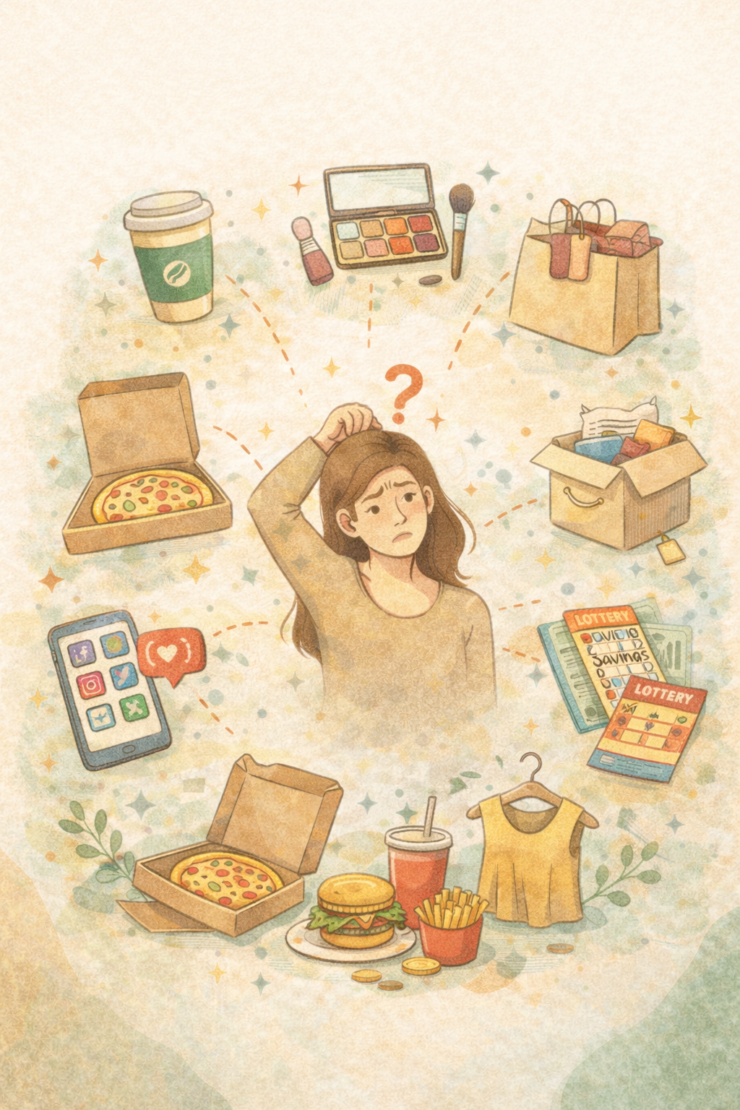
This is not a “you’re bad with money” list. This is not about shaming you for treating yourself or enjoying your life. This is a “your money deserves better than this” list. Because the truth is, most of us are hemorrhaging money on things we don’t even really want or use, while telling ourselves we can’t afford the things we actually care about.
We’re going to walk through seven things to stop buying so reflexively, plus what to try instead. No shame, no judgment, just a strategy that actually works in real life.
Let’s get into it.
1. Unused and “Forgotten” Subscriptions
Streaming services, apps, beauty boxes, software subscriptions, meal kits. It adds up so much faster than you’d think.
Studies keep finding that people drastically underestimate their subscription spending. One survey found that Americans underestimate by about $133 per month on average. Think about that. You think you’re spending maybe $86 a month on subscriptions, but you’re actually spending over $200. Another report found that people spend over $200 a year on subscriptions they don’t even use. Not subscriptions they use sometimes or get value from occasionally. Subscriptions they literally never use.
That’s found money just sitting there, being auto-debited from your account every single month while you’re stressing about not having enough to save.
What to stop buying so automatically:
Trials you signed up for but aren’t actually excited about. You know the ones. “I’ll cancel before they charge me,” except you never do.
Extra tiers you don’t actually use. Do you really need 4K streaming? The premium version? The “family plan” when it’s just you?
Duplicate services. Three different streaming apps so you can watch the same two shows? Pick one.
Try this instead:
Do a 15-minute subscription sweep once a quarter. Just four times a year. Set a calendar reminder so you don’t forget.
Keep a simple note in your phone titled “Subscriptions I Actually Use.” If it doesn’t get used at least twice a month, it goes on the chopping block.
Before you sign up for anything new, ask yourself: “What am I going to cancel to make room for this?” Treat your subscription budget like limited real estate.
2. Food Delivery as the Default, Not the Treat
Food delivery is genuinely magical. The convenience of having restaurant-quality food show up at your door is one of the best parts of modern life. It’s also expensive in a way that’s easy to ignore when you’re ordering.
Recent data shows the average American spends over $1,566 a year on food delivery alone. That’s not even counting actually going out to eat; that’s just the delivery convenience. Each order averages around $35 with fees, tips, and markups.
If your default answer to “What’s for dinner?” has become “Let’s just order something,” your budget is quietly screaming in the background.
What to stop buying:
Delivery out of habit, especially when there’s perfectly good food already at home. You know those nights when you order because you “don’t feel like cooking” and then remember three days later that you have ingredients for an actual meal in the fridge?
Extra delivery treats during the week that you instantly forget about. If you can’t remember what you ordered last Tuesday, was it really worth $40?
Try this instead:
Decide how many delivery nights per month you’re genuinely okay with. Maybe it’s two, maybe it’s four. Pick a number that feels sustainable and fits your budget.
When you skip a delivery night you would have normally ordered, transfer that money (even if it’s just $20-30) into a separate savings account. Call it your “Treats I Chose On Purpose” fund.
Keep one or two easy emergency meals at home. Frozen pizza, canned soup, frozen dumplings, pasta with jarred sauce. Something that requires minimal effort, so delivery isn’t your only escape hatch when you’re exhausted.
3. Little Impulse Purchases That Don’t Actually Make You Happier
We’re not talking about your favorite morning coffee that genuinely sparks joy and makes your day better. We’re talking about the random Target run, the Amazon “add to cart” items, the “it was on sale, so I grabbed it” purchases that you barely remember buying a week later.
Research shows the average American spends around $282 per month on impulse purchases. That’s roughly $3,381 a year. Clothing, groceries, household items, and takeout are some of the most common impulse categories.
That’s a whole vacation. A solid emergency fund. A credit card balance is completely gone. Spent on stuff you don’t even remember wanting.
What to stop buying:
The random add-to-cart items you didn’t plan for and weren’t looking for until you saw them.
Checkout line extras. Those strategically placed items at the register exist because they work, and they’re working on your budget.
Flash sale items you weren’t already actively looking for. Just because it’s 40% off doesn’t mean you’re saving money if you weren’t going to buy it anyway.
Try this instead:
Keep a 24-hour parking lot list in your notes app. When you want to buy something, add it to the list with the date. If you still genuinely want it 24 hours later, reconsider it then.
Give yourself a monthly impulse budget. Maybe it’s $40, maybe it’s $75. You’re not banning treats or spontaneous purchases. You’re just containing them so they don’t take over your entire budget.
Unlink your credit card from one high-risk shopping app and see what happens. The extra friction of having to manually enter your card info can be surprisingly effective at reducing impulse buys.
4. Buy Now, Pay Later for Non-Essentials
BNPL services like Afterpay, Klarna, and Affirm feel harmless. Four easy payments! Zero interest if you pay on time! Future You will totally handle it, no problem!
The problem? Research shows that BNPL often leads people to spend significantly more than they otherwise would. It’s strongly associated with financial stress, missed payments, and difficulty keeping track of multiple payment plans. Surveys find that many users report spending more when BNPL is available and struggling to manage several plans at once.
So that $80 sweater you “only” paid $20 for today? It quietly becomes five open payment plans, three different due dates you have to track, and a “how did my checking account get this low?” moment two weeks later.
What to stop buying:
Clothes, gadgets, home decor, and gifts via BNPL when you can’t actually afford to pay in full right now.
Everyday essentials split into tiny payments. If you’re using BNPL for groceries or basics, that’s a sign something needs to shift in your overall budget.
Try this instead:
Treat BNPL as a red flag filter. If you need to split it into payments, you can’t really afford it right now. That’s not judgment, that’s just reality.
Start a small “want list sinking fund.” Put $20-40 per month toward future fun purchases. Then, when you want something, you can actually buy it outright instead of financing it.
If you already have BNPL balances, write them all down with their due dates. Commit to no new BNPL purchases until every single current plan is paid off.
5. Trendy “Fix My Whole Life” Beauty and Wellness Products
New serums that promise to transform your skin. Mystery supplements that claim to boost your energy. That $48 candle that somehow promises to give you a whole new personality and vibe.
There is nothing wrong with loving beauty products or investing in self-care. The issue is when your bathroom counter looks like a Sephora stockroom, covered in half-opened bottles you don’t actually use, while your bank account is exhausted.
What to stop buying:
New products that duplicate what you already have. You don’t need five different cleansers or three toners that do the same thing.
“Maybe this will fix everything.” purchases driven by stress, insecurity, or the hope that the right product will solve problems that aren’t actually about skincare.
Subscription boxes where you only genuinely use one or two items out of six, and the rest sit in a drawer, making you feel guilty.
Try this instead:
Decide on your baseline routine. A few products you genuinely love, that work for your skin, that you actually finish before buying new ones.
Implement a “one in, one out” rule. You can’t buy a new serum until you finish or declutter one you already have.
Redirect “bored browsing” energy. When you find yourself scrolling through beauty products online, close the app and actually use what you already own. Give yourself a mini spa moment with existing products.
6. Convenience Groceries You End Up Wasting
Pre-cut fruits and vegetables, fancy dips, pre-made salad kits, and pre-marinated proteins. Convenient? Absolutely. But also, where grocery budgets quietly go to die if you don’t actually eat them before they go bad.
Between food waste and premium pricing, convenience foods can seriously eat into your ability to save. Even modest changes in how you buy groceries and reducing takeout can free up meaningful money each month without making you feel deprived.
What to stop buying:
Pre-prepped items you consistently throw away because they go bad before you use them.
“Just in case” fresh produce that you don’t have an actual plan for. You’re not going to suddenly become a person who makes green smoothies every morning just because you bought spinach.
Extra snacks “for later” that never match what the future you actually want when later arrives.
Try this instead:
Plan two to three simple, realistic meals for the week. Not seven aspirational meals that require you to be a completely different person. Two or three that you’ll actually make.
Have a “clean out the fridge” night once a week, where you make something, anything, from what’s already there before buying more groceries.
Buy some convenience, but treat it like a conscious choice. If bagged salad is the difference between eating vegetables and not eating vegetables, buy the bagged salad. Just be honest about whether you’ll actually use it.
7. Duplicates and “Cute Organizers” for Stuff You Don’t Need
Water bottles, coffee mugs, tote bags, notebooks, storage bins, cute baskets, drawer organizers. You might not be buying stuff anymore. You might be buying storage solutions for all the stuff you already don’t use.
Meanwhile, clutter is costing you twice. You spent money to acquire it in the first place. Then you spend more money trying to store it, organize it, and manage it.
What to stop buying:
“Just one more” of things you already own multiples of. Water bottles, mugs, totes, planners, notebooks.
Organize items you never actually use and probably should just donate.
Seasonal decor that you put up for one week, forget about, and then buy new versions of next year because you can’t find last year’s in storage.
Try this instead:
For the next 30 days, commit to only using what you already own. No new purchases of anything you already have at least one of.
For every organizer you want to buy, commit to donating or selling an entire category of items first. Want a new shoe organizer? Great, donate half your shoes first.
Create a “Do I already have something that does this?” rule before you check out anywhere.
Why These “Little” Things Actually Matter
A lot of people think, “It’s just $10 here and $20 there, it can’t be that serious.” But zoom out and look at the actual data.
The average American spends around $282 a month on impulse purchases. That’s about $3,381 per year on things they didn’t plan for or necessarily even want.
One survey found that 74% of Americans say they have an overspending problem. One in six people feels their spending habits have actually ruined their lives. That’s not dramatic language; that’s what people reported.
Subscription studies show that people think they’re spending around $86 a month, but the real number is closer to $219. More than double what they estimate.
Many people are paying over $200 a year for subscriptions they don’t even use. Not barely use, don’t use at all.
You are not imagining it. These small things really do stack up into amounts that could change your financial life.
The goal isn’t to feel guilty about where your money has been going. The goal is to think, “If the math is this wild when I’m not paying attention, what could happen if I flipped it in my favor?”
✨ Millie by Example
A friend told me something that really stuck with me. She said she always thought her problem was the big stuff. Rent, car payment, student loans. She kept telling herself, “There’s nothing left to cut. I’m already living as frugally as I can.”
Then she actually pulled three months of bank statements and went through them with a highlighter. She color-coded delivery orders, subscriptions, and what she called “little treats” that added up to not-so-little spending.
She said she almost screamed when she saw the totals.
Four streaming services she was paying for. A fitness app she hadn’t opened in months. A meditation app she’d completely forgotten existed. And she was ordering food delivery six to seven times a month, averaging $35-40 per order.
She canceled $63 worth of subscriptions in twenty minutes. Then she set a “two deliveries a month” rule for herself. The money she didn’t spend on delivery and subscriptions? She redirected it into a separate savings account she called her “Calm Me Down” fund.
Three months later, she had $500 saved. And nothing about her actual lifestyle felt worse. She wasn’t depriving herself of anything she genuinely valued. She just stopped paying for things she wasn’t really using or caring about.
That’s the energy we’re going for here. Not restriction for restriction’s sake. Just alignment between where your money goes and what you actually care about.
Your First Step (You Don’t Have to Fix All Seven)
Don’t try to overhaul everything at once. That’s how people burn out, give up, and end up right back where they started.
Instead, pick one of the seven categories that feels the most “Oh… yeah, that’s definitely me.”
Do a ten-minute audit. If it’s subscriptions, open your app store and scroll through your bank account. If it’s food delivery, look at your last 30 days of orders. If it’s impulse buys, check your last ten Amazon or Target purchases.
Set one rule for yourself for the next 30 days. Just one. “No new subscriptions.” “Delivery only on Fridays.” “Everything sits in my cart for 24 hours before I buy it.”
That’s it. That’s the whole assignment.
You’re not trying to become a different person with completely different habits and values. You’re just trying to stop paying for things you don’t actually care about, so you have more money for things you do.
✨ Millie’s Money Moment
Not in the mood to read the full post? Here’s the quick hit:
Small spending leaks add up to thousands per year. Most people underestimate subscription costs by over $100/month.
- Pick ONE category to audit this week
- Set ONE rule for the next 30 days
- Redirect saved money to something you actually want
- Don’t try to fix everything at once
💡 You’re not restricting yourself. You’re realigning your spending with what you actually value.
👉 Ready to start? Pull up your bank app right now. Scroll back 30 days. Pick the category that makes you go “oof.” That’s where you start.
Quick FAQ
What if I genuinely enjoy all my subscriptions?
Then keep them! This isn’t about deprivation. But make sure you’re actively using them, not just passively paying for them. If you haven’t watched that streaming service in two months, you’re not enjoying it; you’re just forgetting to cancel it.
Is it really worth saving $20 here and there?
Yes. $20 saved on subscriptions, plus $30 saved on one skipped delivery, plus $25 saved on an impulse purchase you waited 24 hours for equals $75 that month. That’s $900 a year. That’s a solid emergency fund start or a meaningful dent in debt.
What if cutting back makes me feel deprived?
That’s a sign you’re cutting the wrong things. Focus on the stuff you don’t actually use or care about, not the things that genuinely bring you joy. Your morning coffee that makes your day better? Keep it. The subscription box you never open? That’s the one to cut.
How do I know which category to start with?
Pick whichever one made you physically react while reading this. The “oh no” or “oof” category. That’s your starting point.
Final Word
Here’s what I want you to understand. Saving more money doesn’t require you to become someone you’re not. It doesn’t require you to give up every single thing that brings you joy or makes your life easier.
It just requires you to get honest about where your money is actually going versus where you think it’s going. And then make some small, strategic adjustments, so your spending actually reflects what you value.
Most of us are spending hundreds, sometimes thousands, of dollars a year on things we barely use, don’t really want, and wouldn’t even miss if they were gone. While simultaneously telling ourselves we can’t afford to save, can’t afford that thing we actually want, can’t afford to build an emergency fund.
That’s not a character flaw. That’s just what happens when you’re not paying close attention in a world designed to make spending as frictionless and forgettable as possible.
The good news? Once you see where the leaks are, they’re surprisingly easy to plug. Not all of them, not all at once, but one at a time, at a pace that doesn’t make you feel deprived or restricted.
Pick one thing from this list. Just one. Audit it this week. Set one small rule. Give it 30 days.
You don’t have to be perfect. You don’t have to overhaul your entire life. You just have to start paying attention and making one small shift at a time.
Your money deserves to work for you, not just quietly disappear on things you don’t even remember buying.
Stay aware. That’s the real first shift.
— Millie
Add comment