
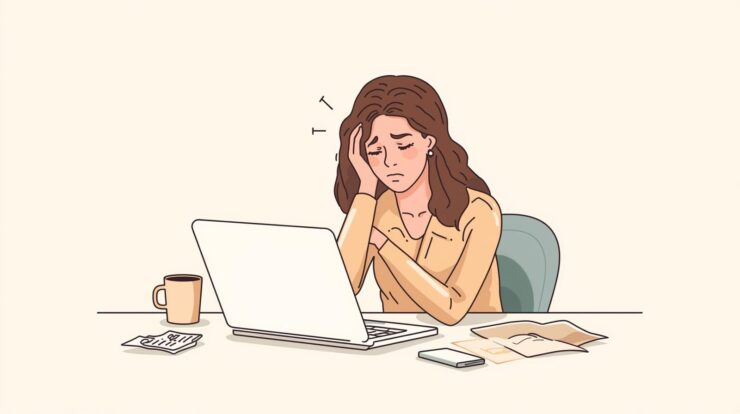
If checking your bank account instantly makes your chest tighten and your stomach drop, you’re not bad with money. You’re not irresponsible or failing at adulting.
You’re human.
For many people, opening a banking app doesn’t feel neutral or informative. It feels like judgment—like opening a report card when you already know the grade won’t be good. The numbers seem loud and accusatory. Notifications feel like criticism. And even when everything is technically fine—bills paid, no overdraft—the simple act of looking can spiral into overwhelming stress.
So you avoid it. You tell yourself you’ll check later, tomorrow, or when you have more mental energy. Until a bill is due or you need to know if you can afford something, and the avoidance has made the situation worse.
Here’s what’s important to understand: this isn’t a discipline problem. It isn’t about lacking willpower or being too sensitive. This is a nervous system problem, and nervous system problems are fixable with the right approach.
Let’s talk about how to make checking your account feel like information instead of judgment.
Where Feeling Overwhelmed with Money Actually Comes From
A person feels overwhelmed when they check their account from one or more of these sources. Understanding which ones affect you helps you address the real problem.
Too much information is hitting you all at once. When you open your app and see dozens of transactions, multiple accounts, pending charges, and no clear organization, your brain can’t process it quickly. It simply registers “overwhelming” and wants to shut down.
No clear structure for where money is supposed to go. When bills, spending money, and savings attempts are all mixed in one account, you can’t tell at a glance if you’re okay. Everything feels uncertain.
Checking reactively instead of intentionally. You only look when you’re already stressed, when something went wrong, or when you’re worried. So your brain associates checking your account with feeling bad.
Guilt is tied to past spending decisions. Every time you see your balance, you’re reminded of purchases you regret or times you overspent. Your brain turns checking into a shame spiral instead of information gathering.
The goal here isn’t to force yourself to check more often or to push through the discomfort. The goal is to change how and why you check, so it stops triggering your stress response.
How This Affects Your Brain and Your Money
The behavioral and nervous system side: Money overwhelm happens when your brain has learned to associate checking your balance with danger, shame, uncertainty, or harsh self-criticism. When that association is strong enough, avoidance becomes self-protection. Your nervous system is trying to shield you from feeling bad—even though the avoidance creates bigger problems.
Changing this pattern requires fewer check-ins, not more. It requires more structure, so you know what to expect. It requires clearer expectations about what “good” even looks like, so you’re not just guessing and panicking.
The practical money side: From a numbers perspective, overwhelm usually means bills aren’t clearly separated from spending money, so you can’t tell what’s actually available. Savings feels invisible or unstable because it’s mixed in with everything else. Your balances don’t reflect your actual priorities because there’s no system organizing them.
When your money has clearly defined roles and lives in appropriate places, checking becomes purely informational instead of deeply emotional. You’re just looking at facts, not getting a verdict on your worth as a person.
✨ Millie by Example
A friend once told me she only checked her bank account when she was bracing for bad news. She’d take a deep breath, mentally prepare herself, and then open the app like she was about to receive test results.
She wasn’t overspending wildly. She wasn’t being irresponsible or ignoring her finances. But every single time she logged in, she felt like she was about to be disappointed in herself. The number was never going to be what she hoped. She was always going to have spent more than she thought or saved less than she wanted.
What eventually changed for her wasn’t her income. She didn’t get a raise or suddenly start making more money. What changed was her system.
Once her bills started running automatically from a separate account, once savings moved automatically in the background without her having to think about it, once her spending money was clearly defined and separated from everything else, checking her account stopped feeling like a test she was taking.
It became just a glance. Quick information. Not a verdict on her life or her choices or her worth.
The numbers hadn’t dramatically changed. But what those numbers meant to her nervous system had completely shifted.
What the Research Says About Financial Anxiety
Research actually confirms what many of us experience but rarely talk about openly: financial anxiety triggers avoidance as a way to protect ourselves from what feels like a threat. Your nervous system is trying to help, but the avoidance strategy ends up making things worse long-term instead of better.
A 2025 study by MX found that 22% of consumers actively avoid checking their finances, with that number jumping to 33% for Gen Z and 28% for Millennials. The primary driver? Fear of feeling overwhelmed by what they’ll see.
Behavioral economics research, particularly work on prospect theory and loss aversion, shows something really important about why we do this. People consistently choose to avoid uncertainty in exchange for short-term emotional comfort, even when that avoidance creates bigger problems later. A 2024 survey by Discover revealed that 41% of Gen Z adults avoid checking their bank balances specifically because of the anxiety it triggers.
Here’s the pattern: you avoid checking because it feels bad. The avoidance provides temporary relief. But the uncertainty of not knowing actually creates more stress over time than knowing the truth would have. You end up in a cycle where avoidance breeds more anxiety, which drives more avoidance.
The research on breaking this cycle supports what might seem counterintuitive: checking less frequently, not more, can actually help when you have solid systems in place. Frequent reactive checking when you’re already stressed increases anxiety. Scheduled, intentional check-ins during calm moments help your brain build positive associations instead of reinforcing the stress response.
Behavioral research consistently shows that when you reduce checking frequency but increase structure and automation, stress decreases even when the actual financial situation stays the same. It’s not about the numbers. It’s about predictability and feeling in control of the process.
How to Actually Stop Feeling Overwhelmed
Here’s how to restructure your relationship with checking your account so it stops triggering your stress response.
Separate your money by purpose. Bills, savings, and spending money should not all live in the same account, mixed together. When everything is combined, every time you check feels high-stakes because you can’t quickly tell if you’re okay or not.
Open separate accounts if you can. One for bills that auto-pay. One for savings that you don’t touch. One for spending that you actually use day to day. The separation creates clarity that your brain can process quickly.
Stop checking reactively when you’re already stressed. Don’t open your banking app when you’re already anxious, when you’re worried something went wrong, or when you’re in the middle of a stressful day. That just reinforces the association between checking and feeling bad.
Instead, choose a calm moment. Maybe Sunday morning with your coffee. Maybe Wednesday evening when you’re relaxed. Make that your regular check-in time when you’re not already activated.
Limit how often you check, don’t increase it. Daily balance-checking often increases anxiety rather than reducing it. You’re constantly monitoring, constantly worrying, never giving yourself a break from financial awareness.
Once a week is enough for most people when you have systems in place. Once a month works too if your systems are really solid and automated. You don’t need constant surveillance. You need periodic information.
Replace judgment with neutral observation. Checking your account isn’t about scolding yourself or looking for evidence that you messed up. It’s about noticing patterns and adjusting your structure, not assigning blame or shame.
Practice saying “I notice I spent more on groceries this month” instead of “I’m terrible with money and can’t control myself.” One is information. One is judgment. Your nervous system responds very differently to each.
Build systems that run without constant supervision. When your money moves automatically, when bills pay themselves, when savings happen in the background, you don’t have to constantly manage and supervise everything. Your role shifts from anxious manager to calm reviewer.
Automation isn’t about being lazy. It’s about removing the emotional load, so checking becomes simple information gathering instead of an emotional ordeal.
✨ Millie’s Money Moment
Not in the mood to read the full post? Here’s the quick hit: If checking your account feels overwhelming, it’s not because you’re failing. Your money system needs more clarity, not more control.
- Separate money by purpose (bills, savings, spending)
- Check intentionally during calm moments, not reactively
- Limit check-ins to weekly or monthly
- Replace judgment with neutral observation
- Automate what you can
- Explore the C.A.S.H. Tool
💡 When your brain knows what to expect, it can relax. 👉 Try this week: Open a separate account for just your bills. Move your spending money somewhere else. See how checking feels when things are separated.
Quick FAQ
Won’t checking less often make things worse? Not if you have systems in place. Constant checking without structure just creates more anxiety. Less frequent checking with good systems creates more peace. Structure first, then reduce frequency.
What if I can’t afford multiple bank accounts? Many banks offer free accounts with no minimums. Look for online banks or credit unions. But even if you can only have one account, you can still track categories separately in a spreadsheet or app to create mental separation.
How do I stop the shame spiral when I check? Practice the observation language: “I notice I spent $X on Y” without the “I’m so stupid” follow-up. It takes practice. The spiral is a habit, and habits can be changed with repetition of new patterns.
What if seeing the number always makes me anxious, no matter what? That might be worth talking to a therapist about, especially if you have a history of financial trauma or scarcity. Sometimes the anxiety runs deeper than systems can solve alone.
Final Word
Here’s what I want you to understand. The overwhelm you feel when you check your bank account isn’t a character flaw. It’s not evidence that you’re bad with money or can’t handle adult responsibilities.
It’s your nervous system responding to what feels like an unpredictable, potentially threatening situation. And the way to address that isn’t through forcing yourself to look more often or trying to just get over it through sheer willpower.
It’s through creating structure and predictability that your nervous system feels safe. Through separating money so checking becomes simpler. Through automating, so you’re reviewing instead of constantly managing. Through checking intentionally instead of reactively.
Your brain is trying to protect you. The avoidance makes sense even though it creates problems. You don’t need to override your nervous system. You need to give it what it actually needs: clarity, predictability, structure.
Start with one change. Separate one category of money this week. Or choose one calm moment to check instead of checking when you’re already stressed. Or set up one automatic payment so there’s one less thing to monitor.
Small changes in how you interact with your money create big changes in how your nervous system responds to it.
Checking your account shouldn’t feel like bracing for impact. It should feel like glancing at information, nothing more emotional than checking the weather.
You can get there. One structural change at a time.
Here’s the Receipts
On financial avoidance and anxiety:
- MX (2025): “Financial Avoidance: The Fears and Habits Holding Your Customers Back” – Study found 22% of consumers avoid checking finances (33% Gen Z, 28% Millennials) due to fear of overwhelm. https://thefinancialbrand.com/news/financial-education/financial-avoidance-the-fears-and-habits-holding-your-customers-back-189384
- Discover (2024): “Survey: Anxiety and Avoidance are Driving the Financial Lives of Many Americans” – 41% of Gen Z avoid checking bank balances due to anxiety. https://investorrelations.discover.com/newsroom/press-releases/press-release-details/2024/Discover-Survey-Anxiety-and-Avoidance-are-Driving-the-Financial-Lives-of-Many-Americans/default.aspx
On financial stress and behavioral patterns:
- Psychology Today (2024): “What Financial Stress Does to Relationships” – Research on how financial stress creates avoidance cycles and affects well-being. https://www.psychologytoday.com/us/blog/financial-matters/202405/what-financial-stress-does-to-relationships
Stay aware. That’s the real first shift.
— Millie


Add comment